Tuesday, October 31, 2006

Learning To Be Grateful


"Like the proud mother who is thrilled to receive a wilted bouquet of dandelions from her child, so God celebrates our feeble expressions of gratitude."
~ Richard Foster~

From the time they were old enough to talk, I wanted my children to learn the art of saying “thank you” upon receiving a gift.

In anticipation of the event, such as a birthday or Christmas, we would talk about gifts, the thought behind the gift, the money spent on the gift, the importance of gratitude and sensitivity to the feelings of the giver.

I can still remember when Sweet Pea was two years old. We were having Christmas with the extended family: grandma, aunts, uncles, and cousins. I sat with her as she opened each gift, shared her excitement, then watched with pride as she set the gift down, scanned the room for the giver, made her way to her chair, wrapped her chubby little arms around her neck, and said, “Thank you so much Grandma!”, before going back to her spot to open the next gift. Needless to say she was always the last one to finish opening all of her gifts. As the years wore on, it became comical to watch as each of my four children opened a gift with glee, set it down, scanned the room then trampled over mounds of strewn boxes and wrapping paper until they found the giver to give that personal “thank you”, then stumbled their way back to their spot to open the next gift.

Since children are an open book, we also talked about facial expressions. Opening a pair of socks from grandma may not have had the appeal of the newest toy, but the love, money, and thought behind the gift were just as important.

We did the same thing for birthdays and birthday parties. At such events, it is not unusual to open a duplicate gift. We actually practiced for such events, so that a petulant, “But I already have one!” could be replanted with, “This is the best. Now I have two!” It worked out pretty well; all duplicate gifts went to Grandma’s house so that they had toys to play with whenever she babysat.

It is not too difficult to express genuine gratitude on special occasions such as birthdays and Christmas, but how does that compare to my daily gratitude? Like the child who expresses great joy over receiving the coveted toy, I frequently express my joy to God over the people and things that mean so much to me. However, like the child who receives socks for Christmas, I often fail to thank God for the things that I need but have come to take for granted: my health, the health of my family, my strength, mental abilities, freedom, democracy, a job I love, a steady paycheck (I could go on and on), until, of course, I am in danger of losing one of these things.

I can’t remember the last time I thanked God for my health until I suffered through two days of a stomach virus. A stomach virus; how small that is when I know of countless people who suffer on a daily basis for years with chronic and even terminal illnesses. Yet I need a wake-up call in the form of a two day virus to remember to thank God for my health.

Can you relate?

“You are my God, and I will give you thanks;

You are my God and I will exalt you.”

Psalms 118:28

Friday, October 27, 2006

The Power of Words (Potential - part 2)

A young man was sent to my office one day by a teacher who was frustrated by his behavior in her classroom.

This high school junior was tall, handsome, intelligent, athletic, out-going, and well liked. His parents were highly successful professionals. Unable to have children of their own, they adopted this boy and his brother when they were babies. His father was an elder in their church and their family was very involved in church activities. He seemingly had everything going for him. However, about the time he entered high school, he chose to run with a fast crowd; their weekends usually involved poker parties with alcohol wherever they could find a home with the parents gone. I never knew if he participated in these activities, but these were the kids he chose as his close friends. By his junior year, we began to see distinct changes in his behavior and attitude.

Sitting in my office, he was not happy. He felt that he had been unfairly singled out by his teacher for something that “everyone was doing”. Knowing that I could not reach him in this state, I allowed him to vent until he calmed down sufficiently so that we could talk. This was not the first time he had been sent to my office, so we already had a good rapport. Rather than berating him for what he had done, I began to ask questions about his plans, his dreams, and his future. I told him about the good I saw in him and in his future. Then I did the unspeakable; I used the “P” word. In my attempt to motivate him, I told him that he had a bright future, tremendous potential.

He exploded.

“I am sick of hearing about my potential!” he spewed.

“Has someone said this to you before?” I ventured cautiously.

“My dad; he’s always talking about my potential,” he snarled sarcastically.

I waited a few seconds then whispered, “What does that mean to you, when your dad says you have great potential?”

He looked me square in the eye and said, “It means I’m not good enough as I am.”

If only we could know with certainty the words that would motivate and encourage our children, and at the same time, assure them of our unconditional love. May our prayer as parents be like the psalmist, David, who prayed:


“Teach me good judgment and discernment, for I rely on your commands.”

Psalms 119:66

Can you think of a time that your well-intentioned words backfired?

Sunday, October 22, 2006

Potential (part one)

When someone tells you that you have great potential, what does that mean to you?

I knew one Christian family whose dad tried to motivate his two sons by praising their potential. One of his sons was encouraged by the fact that his dad saw promise in him, even though this talk usually followed some kind of reprimand. He knew that his dad believed that he could do whatever he set his mind to; he was not forever defined by his behavior as a teenager.

His brother, on the other hand, heard an entirely different message. His dad also spoke of his great potential after he had made a poor choice. However, this boy was not convinced that his dad saw the good in him, because he saw no good in himself. As a result, “you have great potential” to him meant “you are not good enough as you are.”

The two sons grew up. One son became a Christian; the other did not. The Christian son got a college education, married a Christian woman, and had his own sons who also became Christians; the other did not. The Christian son held a respectable job and provided for his family all of his life; the other did not. His life involved drugs, alcohol, crime, failed marriages, numerous jobs, depression, and anger.

What went wrong? Here were two boys raised by the same parents in the same Christian home, with the same upbringing, hearing the same words, yet, their lives took two decidedly different turns that affected generations to follow in very different ways.

One obvious difference between these two boys was their self-esteem, which was deeply affected not only by environment, but their response to that environment. We have all heard stories of children born to wealth who squander their life away, or the inspiring stories of children who grow up in extreme poverty or neglect, only to use that as a catalyst to building a life of achievement and purpose.

A poor self-esteem filters in negative thoughts and words in to further reinforce how that person esteems or values himself. How often do you say things to yourself like, “I am so stupid”, “I have no friends”, “I am so fat (ugly, dumb, fill-in-the-blank)”, or “Why do I do the same dumb things over and over?”

In contrast, a good self-esteem filters in constructive thoughts and words. “Ok, so I blew it. I know I can do better next time.” “It’s been a long time since I’ve done anything with a friend. I need to reach out to others more.” “So I’ve gained a few pounds. Here’s what I need to do to get my eating and exercise back on track.”

A person with a good self-esteem will recognize their shortcomings and weaknesses, but rather than be defined by them, will identify them, own them, and strategize ways to deal with them.

Perhaps what we need is not more self-confidence, but more God-confidence, confidence in God to love us no matter what, confidence in his promises, and confidence that he will mold us and shape us to do his will. How differently the lives of the other son and the generations that followed him would have turned out had he truly understood and accepted the magnitude of God’s unfailing love.

“But blessed is the man who trusts in the Lord,

whose confidence is in him.”

Jeremiah 17:7

Wednesday, October 18, 2006

One Best Friend

By nature, I am a one best friend person. Even as a child, I wanted one best friend, even though I remember having a best friend at home, a best friend at school, and a best friend at church. Still, if forced to choose, I knew who my overall best friend was.

When I got married and moved to a strange town, my beloved was my one and only friend, my best friend. Although I still consider him to be my best friend, it is unrealistic to expect him to take the place of my girls. He won’t get manicures and pedicures with me. He doesn’t like chick flicks. He doesn’t like to exercise, and he hates to shop. He thinks four pairs of shoes are plenty: black, brown, athletic, and work boots. We can’t wear each other’s clothes or try each other’s favorite lipsticks. He refuses to go in a Michaels or Hobby Lobby; he doesn’t appreciate romance novels, and he would rather eat hard candy than chocolate.

I remember sometime within the first few years of my marriage feeling unsettled and dissatisfied. I couldn’t quite put my finger on it, but I found myself very critical of my beloved, as if he could do nothing to please me. Then God taught me something through Dr. James Dobson. I don’t remember which of his books it was, or even if I heard it on his radio show. I do remember that he was talking about our culture; how families have moved away from each other, how we don’t even know our neighbors, and how, with the husband and wife both working outside of the home, wives often do not find or take the time to cultivate close female friendships. He reasoned that most wives, having worked all week, spend their evenings doing those things that housewives do during the day. Weekends are spent with their families. Consequently, they put undue pressure on their husbands to meet all of their needs, even those needs that would better be met by girlfriends with similar interests (review paragraph two).

I took Dr. Dobson’s lesson to heart and looked for opportunities to develop, cultivate, and invest in female friendships. It wasn’t long before my attitude toward my beloved changed as I no longer felt that he and he alone should meet all of my needs. During our time together, we were able to choose those things that we both enjoy, rather than me haranguing him because he doesn’t enjoy to (fill-in-the-blank with something from paragraph 2).

Just like in most things in life, balance is the key. One should never spend so much time with friends that family suffers, but I thank God for my girls.

“Two are better than one, because they have a good return for their work:

If one falls down, his friend can help him up.

But pity the man who falls and has no one to help him up.”

Ecclesiastes 4:9-10


Saturday, October 14, 2006

Find Your Girls

I was talking with the mom of one of my students the other day. I asked about her daughter’s adjustment to college; although she is doing well, her roommate is apparently having adjustment problems. Apparently she hit the floor running by going after the boys, trying to secure a boyfriend before he could be snatched up by another new freshman.

My former student wisely pulled her aside one day and said, “Look, you’re going about this all wrong. You need to find your girls first. Your girlfriends are more important, for they will stick with you long after you have broken up with the boy of the month. Find your girls.”

I was impressed with such sage advice coming from a girl so young. It turned out, though, that this was the advice her mother had given her when she transferred to our high school a few years back.

I started thinking about my girls, the friends who are so dear to me. Each of my girls has an important role in my life.

There are the girls I like to chit-chat with just to pass the time of day. We work together and meet for lunch as often as we can.

There’s the girl I meet every day for exercise. We both bring potential topics to share and whatever we don’t get to is saved for the next time.

There are the girls I go to when I need a boost or someone to pray with.

Then there’s the one girl who can make me laugh like no one else as we share our childhood memories. Come to think of it, she makes me laugh no matter what we are talking about.

There are the girls who swap recipes with me, and those who like to get together and quilt. Some of my girls and I like to share spa days, mani’s and pedi’s, and shopping or road trips.

One of my girls and I manage to squeeze in outlet mall shopping whenever we go to a work-related convention.

I have a group of girls who meet a few times a year for dinner. We helped each other through a difficult time years ago, and although most of us no longer work together, the bond is still there.

Some of my girls are my daughters, some are my colleagues, and some are just friends.

Yep, that’s pretty good advice. First, find your girls and love them for who they are.

“My command is this: Love each other as I have loved you.”

John 15:12

Wednesday, October 11, 2006

Traditions


"These children are the seeds my days plant, the blooms of the next generations."
~ Ann Voskamp ~
"Holy Experience"

We have many traditions in our home. One tradition began when my oldest children were potty-training. My beloved and I took turns sitting with them, trying to keep them on the potty seat occupied with puzzles, books, and conversation until they relaxed enough to let nature take its course. Once that happened, the parent on duty took the “big boy” or “big girl” to the other parent to brag about what they did on the potty. When my beloved brought our child to me, I jumped up and down and clapped, which eventually provided another incentive for using the potty. “As soon as you use the potty, we’ll go tell Mommy and she will jump up and down and clap!” Oddly enough, this worked.

As the years rolled on, Mommy was expected to jump up and down and clap for every bit of good news: finished the puzzle, let’s show Mom. Took a nap, won’t Mommy be proud. Shot the basketball through the goal, let’s go tell Mom. Made an A on the report card, take it home to Mom. It seems I jumped up and down and clapped through each milestone of their lives.

As one by one my children left for college, I wanted there to be no doubt in their minds how happy I was whenever they came home. Sweet Pea attended Pepperdine University in Malibu, California, so her visits home involved airfare and were planned way ahead of time. Each time she came through the revolving door to baggage claim where we waited, her eyes scanned the area, looking for a familiar middle-age woman trying to discretely jump up and down and clap. A year and a half ago, Sweet Pea and her husband announced that they were having a baby. Once again, she looked at me expectantly. Obediently, and with much exuberance, I jumped up and down and clapped, and subsequently pulled a muscle in my back. That was difficult to explain at work. “So, how did you hurt your back?” “Um, well, I kind of jumped up and down and clapped……with gusto. Long story.....kind of a family tradition sort of thing. That’s really all I can say about it.”

Kindred Spirit attended Harding University, which is six hours away. She drove home more than she flew. Not entirely comfortable with this, my beloved and I took turns calling her every hour, checking on her progress. As the time drew near for her arrival, we stood by the curb. As soon as we saw her car turn onto our street, my excitement took over and, bless her heart, she drove up with a big grin on her face as she saw her mom standing by the curb, jumping up and down and clapping.

My Buddy chose Oklahoma Christian University, which is three and a half hours away. He liked to surprise us by pretending that he left later than he did, or was caught in traffic, so he could see the surprised looks on our faces when he appeared at the door hours earlier than we expected. At least that’s what he told us. In reality, as much as he seems to enjoy his old mom still jumping up and down and clapping at his arrival, I think he prefers it at the door to our home rather than by the curb.

Lovey also chose Oklahoma Christian University. She and Buddy just came home for the first time since school started this year, along with her new boyfriend, and her new college best friend. I had to work the gate (take money for admission) at our home football game, so I was not home when they arrived a little earlier than expected. Toward the end of my shift, though, I looked up to see all of them pile out of the car with big grins on their faces. I do hope they warned their friends about their odd mom, because I jumped up and down and clapped as I ran around the car hugging and greeting each one.

The father of the prodigal son had a similar strategy.

“But while he was still a long way off, his father saw him and was filled with compassion for him; he ran to his son, threw his arms around him and kissed him.”

Luke 15:20

Won’t it be great when God greets us the same way as we enter heaven?

Tuesday, October 10, 2006

Humbled (part 2)

My second most recent humbling experience took place at church. At our church, parents of children birth through 5th grade must check their children in at one of the new computerized kiosks located in the children’s wing. Parents give the volunteer the name of their family and child, and the volunteer locates their names on the computer screen and prints computerized name tags with bar codes. Only the parent with the matching bar code may pick their child up after Bible class.

Since this is a fairly new system, only the two children’s ministers have been trained to use it. Their efforts to elicit volunteers to man these kiosks have been unsuccessful so my daughter, who is the technology minister, volunteered to help out. Computers are her business. She is a fast learner and simply walked up, asked if she could help, and in minutes took over the booth. After her first Sunday to help out, she told me about it. I asked if she thought it was something I could do, and she eagerly replied, “Sure, it’s easy. I can show you how real fast.”

“It’s easy.” That simple sentence should have been my first clue that I was in big trouble. The next Sunday, I marched up to the kiosk, ready for my on-the-job training. As the children’s minister saw me coming, her face broke out in a huge grin. She backed away from the kiosk she was working, grabbed her keys, thanked me for coming and over her shoulder said, “It’s easy. Just follow the yellow brick road. That’s really all you need to know. Follow the yellow brick road.”

What does she mean by that? As the line to my kiosk began to stack with one frazzled parent after another, each holding the hand of a restless child, I’m staring at my computer screen with color coded buttons that I am supposed to touch in a certain order to indicate the age and class of each child. My daughter leans over and says, “When in doubt, push the yellow button.” Fairly certain that I might be able to execute this registration I look up at the first parent.

I smile a little uncertainly. “Good morning. Name please?” “Schneider.” “Could you spell that please?” “S-c-h-n” “That’s all I need. I’ve found you. Who are you checking in today?” I navigate through each of the steps to check their child in, stopping my daughter at the next kiosk each time I hit the wrong button so she can get me back on track. As she stops checking in her family to correct my errors, I look sheepishly at her family and mine. “I’m sorry for the delay. This is my first time.”

After checking in a few families and needing my daughter’s help on each one, I decided to start off on the right foot with those in my line. “Good morning. This is my first time. Please bear with me.” Then the next parent steps up. “Good morning. I’m new and kind of slow. I’ll be just a moment.” “Good morning. How are you today? I’m new at this.”

As the morning progressed, this greeting became my mantra. After one agonizing, slow, fumbling check-in after another, I looked up to find that my line was empty. All the children were checked in. I made it.

I still say that on-the-job training is not my favorite, especially with an audience of restless children and frazzled parents, but every once in a while, a little dose of humility is probably a good thing.

"Humble yourselves, therefore, under God's mighty hand,

that he may lift you up in due time."

I Peter 5:6


Wednesday, September 27, 2006

Humbled (Part 1)

I had two humbling experiences this week. This one took place at school.

I am feeling pretty proud of myself, having volunteered to work the gate at our school’s volleyball tournament on Saturday. I sign up for the two hour early morning shift. Being a morning person, I know I can be perky, take their money, and give directions to the various courts, all at the same time, but, no. The Athletic Director looks at the sign-up sheet and says, “It’s easy to get people to work the gate; I need you to work the clock.” “But I’ve never worked the clock!” The panic is evident in my voice. “It’s easy. Every time a team scores, you push two buttons.”

It’s easy, he says, assuming that those two simple words will calm me down. But if it is not be easy for me, I will feel really, really stupid.

On Saturday morning, the varsity volleyball coach, thrilled to see that I have shown up, greets me with a smile. “Just so you know, I’ve never done this before.” “It’s easy,” he says. “Just push these two buttons when someone scores. Oh, and you’ll need to set the timer when someone calls a time out. Just push this button, this button, and then this one. And remember, it is very important to push this button to the off position before you reset it. You’ve kept the books at games for years. Compared to that, this will be a piece of cake.” As he walks away, I look down at the endless array of buttons I have to choose from, none of which have an obvious off position.

What have I gotten myself into? I love to learn new things, but not like this! I like advance warning, time to practice, and, most importantly, written directions. What I have is learn as you go in front of coaches, players, parents, and refs, every mistake noticed, every mistake public, humbling, humbling, humbling.

I muddle through and two hours later I am finished, having managed to work the clock for six games with just a few mishaps. This is one time when, instead of being proud to have learned something new, I am definitely humbled by it.

“Humble yourselves before the Lord, and he will lift you up.”

James 4:10

Thursday, September 21, 2006

Stretch Armstrong

One of my son’s favorite toys as a little boy was a rubberized doll called Stretch Armstrong. Stretch was unique in that his arms and legs could be pulled and stretched to about four times their original length. Stretch could not stretch himself, though. The stretching required an outside source.

The same is true of my Christian walk. Every time I submit to the will of God, I stretch a little. Every moment I spend in the presence of God, I stretch even more. On my knees, stretch, in the word, stretch, serve others, stretch, deny myself, stretch.

Even though it appears I am stretching, changing, and growing as a result of these things, in reality, just like Stretch Armstrong, I can’t stretch myself. Only God can stretch me. Only God can change me.

And we, who with unveiled faces all reflect the Lord's glory, are being transformed into his likeness with ever-increasing glory, which comes from the Lord, who is the Spirit. 2 Corinthians 3:18 (NIV)

Wednesday, September 20, 2006

Gratitude

My beloved and I are on a plane headed for Dallas from Kansas City. With security heightened it has taken longer than usual to get through security checkpoints. In addition to the usual forbidden items, they have recently added any liquid, gel, or paste. After searching my purse, they threw my brand new, unopened water bottle away.

I should have known, but a little inconvenience in the name of safety is a small price to pay. I positioned myself across from the security checkpoint, watching each person’s reaction as they were pulled aside for a body or carry-on search. Most patiently followed the directives of the airport personnel, but some travelers went out of their way to let everyone know how annoyed they were.

How soon we forget. No doubt every passenger who boarded what would become their tomb on September 11, 2001 anticipated a routine flight. No doubt their primary concern that day was catching their plane.

I have been to other countries where it was commonplace to see soldiers stationed throughout the airport with machine guns, and this was before September 11. I read that anyone flying out of New Delhi, India should arrive three and a half hours before take-off. Sure puts the ninety minutes required for my flight in perspective.

Unfortunately, while security measures are tightening all over the world, we in the U.S. are adjusting to some of these issues for the first time. While we have no choice but to follow these security measures, we are in complete control as to how we respond to them.

What if I were to respond with gratitude? Would I be more tolerant as I stand in line to check in? Would I smile and say a kind word to the one who x-rays my luggage or to the one who checks my ID? Would my gratitude be evident as I put all of my belongings in a tub to be x-rayed? As the alarm goes off and I am pulled aside to be searched, am I grateful that TSA is taking every precaution for the safety of all passengers? Will I thank every employee I come in contact with who is just doing his job? Is it possible to be grateful and it not become evident to those around me?

“Give thanks in all circumstances, for this is God’s will for you in Christ Jesus.”

I Thessalonians 5:18

Monday, September 18, 2006

Expired

My beloved and I planned a relaxing weekend getaway to visit Kindred Spirit and Sammy in Kansas City. We purchased our airline tickets months in advance. We printed up our own boarding passes the night before.

The day of our trip, we left in plenty of time to leave our car in long term parking and still arrive 90 minutes before take-off as recommended. We hopped aboard the shuttle that would drop us off at the door to our terminal. Or so we thought. Neither of us paid any attention to the destination of the shuttle we chose. It was not until it arrived at terminal E that we realized that it was not going anywhere near terminal A, which was our destination. Bailing out at terminal E, we ran half a block down the sidewalk and tried to get on two more wrong shuttles before landing on the shuttle that would deposit us at the door to terminal A.

At this point we still felt pretty good, that is, until we checked in our luggage and showed our identification and boarding passes to the lady behind the counter. She peered over her glasses. “I’m sorry sir. It’s expired.” “What’s expired?” my beloved asked. “Your driver’s license,” she answered. “Apparently you had a birthday four days ago. Well your license expired then. That means your boarding pass is no good.” “No good?” “No good. I’ll have to print you another one; and you really need to get that license renewed.”

She printed another boarding pass and attached a sticker to it. This sticker flagged my beloved as the person who is attempting to board a plane as a passenger with an expired driver’s license. As a result, while I sailed through security both to and from Kansas City, he was pulled over and searched, first with a wand, then by hand.

My beloved chose to be good-natured about the whole thing. His driver’s license is, after all, expired, and while I don’t understand the connection between an expired driver’s license and terrorist activity, I am deeply appreciative of our government’s attempts to protect us in the air.

It just goes to show that no matter how well we plan, things happen that are beyond our control. What is within our control is how we respond. As the apostle Paul wrote from behind bars:

“Your attitude should be the same as that of Christ Jesus.” Philippians 2:5

Saturday, September 16, 2006

It Could Have Been Worse

My wallet was stolen. I don’t know when. I don’t know how. I certainly don’t know by whom. I do, however, know how much. Using two ATM cards, and two credit cards, he or she managed to do over $2200.00 worth of damage to my checking accounts and credit card accounts in one day, before I even knew the wallet was gone and before the banking institutions put a temporary freeze on the accounts due to “unusual spending activity.”

Friday: I spend all evening canceling those cards, filing a police report, and sinking into a black hole.

What am I going to do? Gotta pray. Give it to God. Don’t worry.

How can I get out of this black hole?

Saturday: I make a list. I call it:

It Could Have Been Worse

…if my social security card had been in my wallet (identity theft)

…if the banking institutions had not put a freeze on the accounts when they did

…if the bank had chosen not to believe that those were fraudulent charges

…if the bank had not replaced the money stolen from my checking accounts

…if they had been able to access my savings account with my ATM

…if I were not getting paid in a few days


Sunday: this praise hymn gets stuck in my head:

When upon life's billows
You are tempest-tossed,
When you are discouraged,
Thinking all is lost,
Count your many blessings,
Name them one by one,
And it will surprise you
What the Lord hath done
Refrain:

Are you ever burdened
With a load of care?
Does the cross seem heavy
You are called to bear?
Count your many blessings,
Every doubt will fly,
And you will be singing
As the days go by.
Refrain:

When you look at others
With their lands and gold,
Think that Christ has promised you
His wealth untold;
Count your many blessings,
Money cannot buy
Your reward in heaven,
Nor your home on high.
Refrain:

So, amid the conflict,
Whether great or small,
Do not be discouraged,
God is over all;
Count your many blessings,
Angels will attend,
Help and comfort give you
To your journey's end.
Refrain:

Refrain:
Count your blessings,
Name them one by one;
Count your blessings,
See what God hath done;
Count your blessings,
Name them one by one;
Count your many blessings,
See what God hath done.

J. Oatman Jr., 1897

Monday: I feel better already!

Wednesday, September 13, 2006

I'm Sorry

Why is it so hard to say, “I’m sorry?”

Why are others sometimes resistant to accepting my apology?

Is it them?

Is it me?


I used to be queen of the flippant, “Sorry!”

How about the belligerent “Ok, so I’m sorry. Now are you happy?!”

Then there’s the sarcastic, “I’m sorry already!”

The annoyed, “I said I’m sorry. What more do you want?”

The demanding, “How many times do I have to say I’m sorry?”

Or how about, “Once again, I’ll be the one to apologize!”

I used to get hung up on being right, on winning the argument. And I sure wasn’t going to apologize if I did not do anything wrong (in my way of thinking), or, if I was not the one that started it in the first place. For example, "I only said that hurtful thing to you because of what you said to me." The "You started it so you need to apologize to me" line of reasoning.

Many years ago, I realized that I had no clue how to apologize, because my apologies never seemed to help the situation. Here I was, patting myself on the back for saying, “Sorry!”, while at the same time, my words, my tone, and even my body language were sending another message.

Who is supposed to apologize, anyway? The one who started it? The one who acted the worst? I used to think so, but who is going to make that call? Honestly, I no longer think the answers to those questions are important. I have discovered that there is usually something for which I need to apologize, whether I started it or not.

Think of an apology as salve. Let’s say your body is burned and you need some type of medical attention, fast. You want salve, slathered on, coating your burn, going deep into the wound. Then, and only then, will you relax as you feel it begin to do its work. It numbs the pain. Oh, you still have the wound. You still remember the pain. You may even feel vulnerable, fearing that the pain will return. It will take time to heal completely, but you can deal with it because of the salve.

I think for the apology salve to work, I also need to act fast. Here are some things I have come to believe are important when I apologize.

1. I think of apologizing as an event that deserves my undivided attention. I want to send the message that what is about to happen is important. It will mean turning the TV off or stepping away from loading the dishwasher.

2. I will use my loved one’s name. Who doesn’t love the sound of their own name?

3. I will look my loved one in the eye. The eyes are the window to the soul. It is my loved one’s soul I have wounded. It needs the salve.

4. I will gently touch my loved one as I speak. I will be sensitive to this because he may be so hurt he will not welcome my touch. If that is the case, I will try touch later when the salve has had time to take effect.

5. I will use my soothing voice, which to a loved one is a salve of its own.

6. I will say, “I’m sorry” in descriptive terms. For example, “Loved one, I’ve been thinking about it, and I realize that I owe you an apology. I hurt you when I (fill in the blank with specifics). I love you and I am deeply sorry. " Here the salve is going directly to the wound.

7. I will give my loved one time alone, time to heal. I will accept that I cannot regulate how much time that will take.

8. I will pray for my loved one’s healing and for the relationship to heal.

9. I will realize that my loved one may feel vulnerable, fearing that the pain will return.

10. I will take care to give my loved one and our relationship extra care and attention, just as I would if he were hurt physically.

I think Peter has the right idea.

Finally, live in harmony with one another; be sympathetic, love as brothers, be compassionate and humble. Do not repay evil for evil or insult with insult, but with blessing, because to this you were called so that you may inherit a blessing.”

I Peter 3:8-9

Monday, September 11, 2006

Mayonnaise Sandwich

When we were first married, my beloved was in the Air Force. We lived in town the first year and he commuted to the base just outside of town. From time to time, one of the other airmen would call for a ride. Usually he didn’t mind, but he always dreaded the call from Larry.

Larry was in his early 20’s, married, with children. His wife stayed home to care for the children and money was scarce. Every day Larry packed the same lunch: mayonnaise sandwiches. He took two pieces of white bread, slathered mayonnaise in between, and called it a sandwich. Now, that’s just sad.

Even sadder were the stories he told. He told great tales about dating movie stars, or about his previous job as a commander in the Russian military. My beloved could never tell if Larry believed his own tales, or if he created this fantasy world as a way to cope with the realities of his real life.

That was over 30 years ago, but I’ve never been able to forget that mayonnaise sandwich. It had nothing of substance, nothing of value. Yet he filled up on it every day.

What do I fill up on every day that substitutes for substance, for nutritional value (physical or spiritual) in my life? Is it television, the internet, my own thoughts, or just piddling? Is it complaining, worry, depression, or just idleness? Do I get so distracted by the urgent that I lose sight of the important? Is it just me, or does this happen to you?

It happened to Martha. Her sister, Mary sat at the feet of their guest, Jesus, “listening to what he said.” Martha, on the other hand, was “distracted by all the preparations that had to be made” and complained to Jesus about it. “Lord, don’t you care that my sister has left me to do the work by myself? Tell her to help me!”

“The Lord answered, ‘Martha, Martha, you are worried and upset about many things, but only one thing is needed. Mary has chosen what is better, and it will not be taken away from her.’” Luke 10:38-42

Friday, September 08, 2006

Happy Birthday To Me

I don’t look different. I don’t feel different, but I am.

As of today I am 50.

50 years old.

Fifty.

Five-0.

The big 5.

I’ve been calling myself 50 for several months now, trying to get used to it.

AARP has been stalking me for months; they send me stuff in the mail on a regular basis.

Have you ever lined up pictures of yourself that span decades? Did you notice that with each passing decade your eyes look more and more weary? Try doing it in reverse. I found a recent photo of myself, and one taken about 20 years ago. I could not get over how rested I looked in the younger one. Sure didn’t think so at the time with four children under the age of 8.

I’m one of those kinds of people who go to a workshop or a meeting and checks each item off the program or agenda as it is completed. I feel like I have been doing that with each phase of my adult life.

Got married. Check.

(Spent months planning for the wedding day and not one minute planning for the marriage)

Finished graduate school. Check.

(Had no clue I would go back to school 20 years later)

Done with pregnancy. Check.

(Ok. A little day surgery backed that one up)

Last child in school all day. Check.

(Thought it would mean more time to my self. In reality meant going from part time to full time work.)

Became a grandma. Check.

(Ok. That one's a first, but too important not to mention. I’m in the club!)

Last child left for college. Turned 50 two weeks later. Check. Check.

(Too much to process all at once.)

In contrast, I have decided to approach the second half of my life (positive thinking) as an adventure. As long as God continues to bless me with good health, I refuse to just sit and look, or twiddle my thumbs, or waste away in front of the TV. This time around, I want to check off firsts, not lasts.

Started blogging. Check.

(Met some really neat Christian women/fellow bloggers on-line as a result.)

Started taking a spin class. Check.

(Hardest workout I’ve ever had, next to running. I feel great!)

Learning Spanish. Check.

(Invested in a conversational Spanish program that I listen to in the car. It’s a start.)

Meet my friend Nancy at 5:45 a.m. for power walking. Check.

(Each one brings a topic of the day to discuss. Time flies!)

That’s all I’ve got so far, but the adventure has only begun!

"Even when I am old and gray, do not forsake me, O God, til I declare your power to the next generation, your might to all who are to come."

Psalms 71:18

Tuesday, September 05, 2006

Icky Twerp & Slam Bang Theatre


"Don't let schooling interfere
with
your education."

~ Mark Twain ~

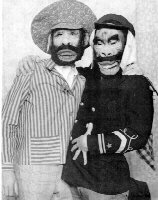
As a child of the sixties in Dallas, I enjoyed watching a local TV show called Slam Bang Theatre on channel 11 at 7:00 a.m. Hosted by the late Robert Camfield, who played a goofy looking fellow named Icky Twerp, the one hour show ran the Three Stooges, Edgar Kennedy shorts, and cartoons such as Mighty Heroes, Mighty Mouse, Popeye the Sailor, and Rocket Robin Hood. Icky had an assistant with an ape-mask named Ajax who would pedal the projector as Icky Twerp said “roll ‘em”. In between shows, Icky picked children from the studio audience to come on stage and participate in contests. My favorite contest was when he timed children to see who could hold their breath the longest. I also participated from the comfort of my living room and (in my estimation) always held my breath longer than any of those kids on TV.

This no-frills, low budget, childish television show concept (come on, a gorilla mask?) was immensely popular to children. It grabbed our attention and held it for one hour. I got up early to watch it in the morning. I even hurried home in the afternoon to watch it again after school. Why? Icky Twerp. He risked looking foolish to adults to get down on my level so that he could relate to me. He presented me with childish humor, he spoke my childish language, and he gave me childish entertainment.

Many adults (my parents included) considered time spent with Icky Twerp a waste of time. In looking back, though, he taught me some valuable lessons that have broad applications about relating to children, especially in my current job as a high school principal. While I have never donned a spiky wig or ill-fitting suit to make kids laugh, I have learned that my impact on the students is directly related to the relationship I have with them. Here are a few of the lessons Icky modeled for me:

Get to know your audience on a personal level.

Icky used children in the audience as contestants and he talked to them on their level.

I begin the school year by learning all of my student’s names (thank you, flash cards). There are only 250 in our high school so it is not too difficult. Who doesn’t love the sound of their name?

I think it is important to learn who plays athletics, which students are in choir, band, theatre, or student government, who is not involved in any way, and who has interests outside of school. Hopefully this communicates that what is important to them is important to me.

Discover their likes & dislikes.

Icky knew what cartoons and shows kids would like. He knew they had to be short, in keeping with our attention span, and varied to keep us interested.

I use student surveys, student advisory councils, and town hall meetings to give kids a forum whereby they can voice their opinions and know that they will be heard and their wishes considered. When decisions are reached with the help of these councils, I announce the results to the student body giving full credit for the decision to the advisory council. The goal here is to empower the student body, while at the same time giving them ownership of their school. With ownership comes responsibility.

Discover what makes them laugh and be willing to risk looking foolish.

Icky knew that we would not be frightened or intimidated by him if he dressed in a goofy way. He deliberately acted silly so we would laugh and enjoy being with him.

My teachers and I try to create fun activities for the kids, to balance out all of the structure and rules. There are a few times a year, like homecoming and Christmas, when the teachers and I act out skits or sing silly songs to entertain the kids.

Let the kids know how much you enjoy their company.

The kids in the audience could tell that Icky got a kick out of being with them.

Before and after school, during lunch, and in between classes, I walk the halls and interact with students. I try to attend the same number of games of each sport. I also go to choral and band concerts, as well as theatrical productions. Each week, we have a student recognition assembly, where kids are recognized for their accomplishments, their servant leadership, and given prizes for good behavior (no demerits).

Do what you enjoy and enjoy what you do.

Icky clearly loved his job. He was consistently happy and bubbly.

Each week during student recognition, I remind the kids that there are 250 reasons why I love my job. Beyond that, however, it is important each day that my words, my tone, and my attitude leave no doubt. Some days, this is easier than others!

That’s it. That’s pretty much all I learned from Icky Twerp, but what a valuable education it turned out to be!

Saturday, September 02, 2006

Majestic Porch

Last May, my entire family journeyed to Florida for vacation, all 9 of us. My beloved and I drove down with my son-in-law Yibby (childhood nick name), and Lovie. Sweet Pea, my precious grandson (Little Bud), and Kindred Spirit flew, so that Little Bud would not have to endure the 12 hour car trip. My other son-in-law, Sammy (inside joke regarding his feet, which look like big, thick sandwiches) flew with My Buddy as neither of them could stay the entire week.

We rented a house in a beautiful community called Watercolor. There were blocks and blocks of Victorian homes just minutes from the beach, some inhabited by their owners, and some built as investment properties. There was a community pool across the street from our house. Our rental home was provided with four bicycles, which we used every day to ride miles and miles of bicycle trails within and surrounding the area.

I rode my bike for hours every day. One of my favorite rides was to a neighboring resort area called Seaside. Every day, I took off for Seaside, cut through the touristy shopping areas, and headed for the residential area just off of the beach. Like Watercolor, the Seaside community is a mixture of residences and rental properties. My favorite home was a two-story colonial bed and breakfast with a majestic porch. Each day, I stopped in front of the house and stared. I even took my camera one day and surreptitiously took pictures of that porch. It was breathtaking. A real Gone With the Wind southern plantation colonial home. I fully expected to see Scarlett O’Hara pull up in a horse and buggy, wearing those parlor drapes, or to find her out back in the dried up garden blowing the dust off of that radish, “As God is my witness, I will never be hungry again!”

Occasionally, I would coerce another family member to go with me to see Majestic Porch. One day, Kindred Spirit and I were parked on our bikes in front of the house. I could not take my eyes off of that porch. Kindred Spirit said, “Why don’t you knock on the door and ask to see the house? It is a bed and breakfast after all. I’m sure the owner will be flattered and show you around.”

I mustered up my courage, leaned forward, and headed for the porch. As I reached the top step, the door flung open and a grim-looking older woman filled the doorway. “Yes?” she drolled. Absolutely terrified, I plastered on my cheery face and stammered, as her eyes bored into me. “Hi. Um. I noticed that this is a, uh, bed and breakfast. We are vacationing in the area and, well, uh, I thought that next time, er, maybe we might consider staying here, you know. Your home is so beautiful. Do you have any, uh, information we can take with us?”

She continued glaring at me for a moment then turned to go inside, pulling the door almost shut as I craned my neck to get a glimpse inside. She returned to the porch a moment later and thrust a piece of paper in my hand. “Here,” she said. “These are the prices.” With that she turned and went inside, shutting the door firmly behind her. Kindred Spirit and I just stood there. We looked at each other and, shoulders slumped, walked slowly back to our bikes. “Sorry, Mom, my mother-in-law usually has a good response when she does that kind of thing.”

We rode our bikes back in silence. I was so disappointed. I assumed that, based on the beauty of that façade that the inside must be just as beautiful, but I was wrong, because the beauty of the inside is dependent on those who inhabit it.

How often do I do that with people? How often do I assume that an attractive person is warm and sweet and worth getting to know? How often do I not even notice someone who might not be as attractive on the outside? How many times have I taken the time to get to know someone, only to find them more attractive once I did, because the beauty of their heart transcended their outer appearance?

“The Lord does not look at the things man looks at.

Man looks at the outward appearance, but the Lord looks at the heart.”

I Samuel 16:7

Tuesday, August 29, 2006

So Ready

So I was standing in line in Walmart a couple of weeks ago, waiting to check out. The longest, loudest crack of thunder boomed overhead. It was followed by a deafening silence as everyone stopped what they were doing and looked at those around them. Then, just as unexpectedly, a spontaneous cheer erupted throughout the store as it occurred to everyone what had just happened. Thunder usually means rain, and we are so ready for rain!

I hurried through my checkout process (I’m one of those weirdoes who likes to check myself out), pushed my basket out the door and looked up, expecting to see dark, angry clouds. I was so disappointed to see that the sun was shining brightly and it was just as hot as ever.

So, it was a false alarm, but it did make me think. What will it be like when Jesus comes? If I’m standing in line in Walmart instead of looking up at the clouds, how will I know? Will there be a deafening silence as everyone stops what they are doing and looks around them? Will a spontaneous cheer erupt throughout the store as it occurs to everyone what is happening? Are we so ready for Jesus to come?


"You must be ready,

because the Son of Man will come

at an hour when you do not expect him.”

Luke 12:40

Sunday, August 27, 2006

Parched

Texas is hot in the summer by anybody’s standards. It just is.

Last night at the Dallas Cowboy’s football game against the San Francisco 49ers, the announcer said that the temperature was 120 degrees on the field at the start of the game. No doubt he was referring to the heat index, rather than the actual temperature, but hot is hot. He expressed his relief that an hour later it had dropped to a balmy 107 and added, “It’s really not that bad down here on the field.”

Julia Glick, in an article for Associated Press in Dallas, referred to “a searing Texas summer marked by drought and 100-degree days”.She went on to say that “the cities are sweating out their hottest year on record so far and the state as a whole is in the running for its most sweltering year on record.”

In addition to the heat, which we have come to expect in the summer, this drought is also serious business. We have been operating under water restrictions all summer. Basically, we are only allowed to water our lawns one day a week, depending on whether our address ends with an even or odd number. Check out: http://www.thepointhocc.blogspot.com for one congregation’s efforts to unite believers in prayer for rain. According to the National Weather Service, we have a 40% chance of rain today and a 90% chance tomorrow. Lord, open the sky and rain down on us!

“Blessed is the man who trusts in the Lord,

whose confidence is in him.

He will be like a tree planted by the water

that sends out its roots by the stream.

It does not fear when heat comes;

its leaves are always green.

It has no worries in a year of drought

and never fails to bear fruit.”

Jeremiah 17:7-8

Friday, August 25, 2006

I Now Pronounce You Man and Husband

I now pronounce you man and husband.

Hmmm... This is not what you think.

This, in fact, is what the preacher said when my beloved and I were married over 30 years ago, and I am to blame.

This poor man had conducted dozens of weddings prior to ours and I am sure he thought ours would be another routine ceremony with the usual vows. I was all of 19 (yes, it is embarrassing to admit that), but had very definite opinions about what I wanted.

In this case, I had a hang-up about the preacher pronouncing that we were man and wife. As I reasoned, he was a man; I was a woman. As a married couple, why is he still a man, but I have become a wife? I felt very strongly that the pronouncement should acknowledge that change was ahead for both of us, not just for me (even though I did have the whole name change thing). When we met with him to discuss the ceremony, I respectfully, yet firmly requested that he pronounce that we were husband and wife.

I could tell that this was unsettling to him. I could not imagine why. Maybe he had said the same thing so much that he did not even have to think. He could set the cruise control as he began the ceremony and reach consciousness in time to have cake. Nevertheless, he agreed to my request. So there we were, at the end of the ceremony, having said our vows, getting nervous about the big kiss in front of everyone, when he said it.

“I now pronounce you man and husband…er, I mean…husband and wife.”

With the maturity of a 19-year-old, I looked at him through slanted eyes, convinced that he did it on purpose, just to get me back for making him think during my wedding ceremony. However, he did say wife, and I liked the sound of that, so my irritation was quickly forgotten.

Isn’t it interesting that I remember nothing else that was said, except that my very nervous groom, while repeating his vows said, “Till dearth shall part us,” which, of course, marks another time that my immaturity reared its ugly head as I broke out in a fit of giggles. I was already crying (with happiness) at the time, so with the tears and the runny nose and the giggles I had a lot going on while trying to repeat my vows.

I look back on those two kids and how little they knew about life and about each other and I thank God for blessing that union of man and husband…er…wife.

“For this reason a man will leave his father and mother and be united to his wife, and the two will become one flesh. So they are no longer two, but one. Therefore what God has joined together, let man not separate.” Mark 10:7-9